
When One Sphere Becomes a Network
Sphere Entertainment has made clear that its ambition isn’t a single icon venue, but a network of Spheres across multiple markets and capacity tiers. Its significance is economic, not architectural.
The Real Cost of Sphere Content
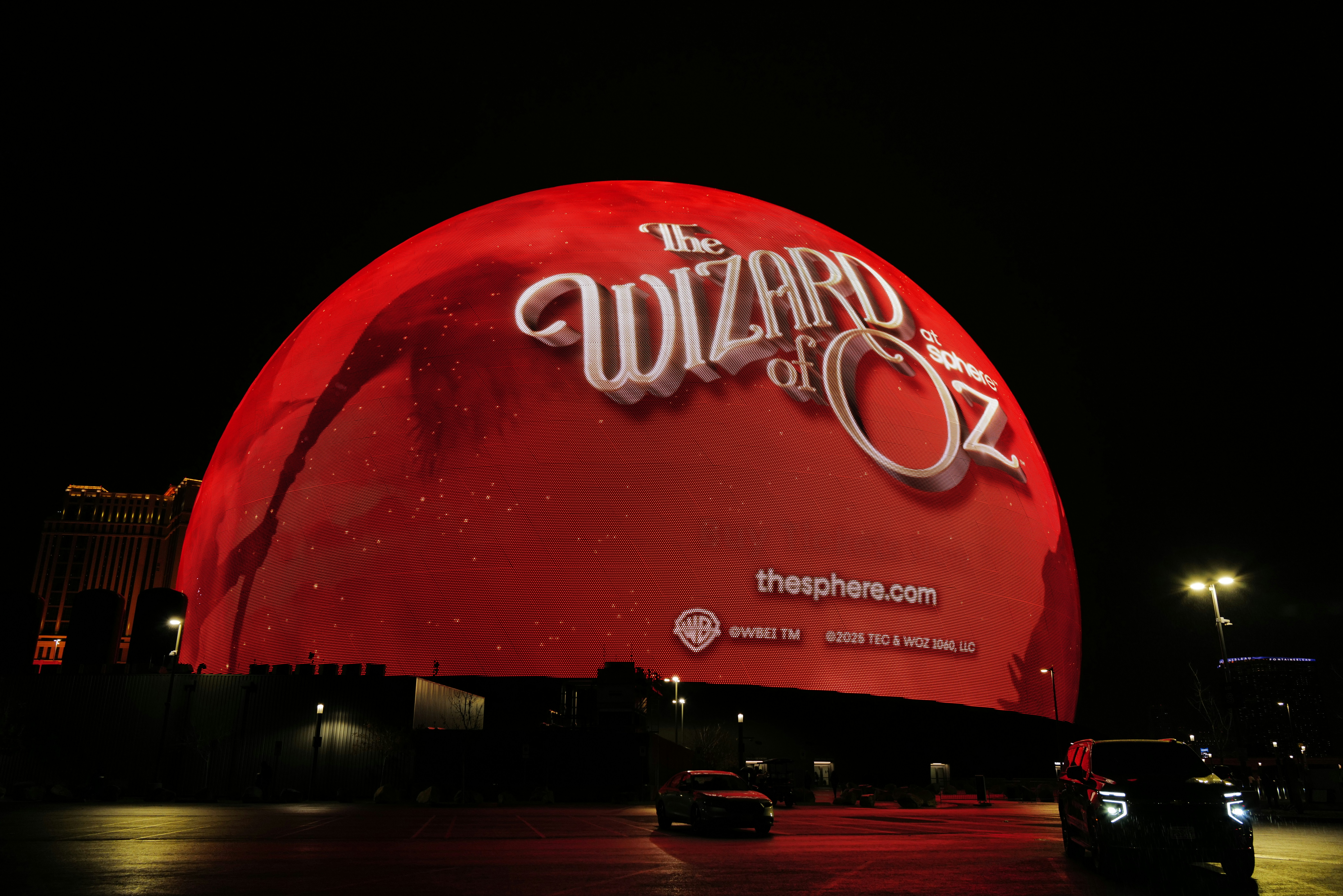
Producing content for Sphere is capital-intensive. Whether it’s musical artists developing custom visuals and spatial audio, Sphere originals like Postcard from Earth, adapted IP like The Wizard of Oz, or private corporate events, the upfront investment is substantial. It includes sound design for dense speaker arrays, haptics, motion cues, and synchronized environmental effects. To date, that investment has largely had to clear the hurdle of a single venue.
A network of Spheres changes the return profile.
Incremental Costs vs. Structural Costs
This doesn’t make content fully portable. Sightlines, acoustics, pacing, and physical effects vary by venue, and adaptation costs are real. But once a multiple Spheres exists, those costs become incremental, rather than structural. The most expensive inputs – concept development, world-building, multi-sensory design, systems, and production pipelines – can be leveraged across more than one deployment.
Who Benefits from a Networked Model
For artists, that lowers the risk of developing Sphere-specific work and makes limited runs more viable. Immersive content starts to behave more like scalable IP for filmmakers and rightsholders. For corporate and private events, Sphere becomes a repeatable platform rather than a bespoke indulgence.
The same economics apply to brand partners. Activations on the exosphere and inside the building, like the recently announced Delta Air Lines Delta SKY360° Club, become far more attractive when they can be deployed across more than one Sphere. Partners can amortize creative development, spatial design, and systems integration across venues, turning sponsorships into a repeatable, high-impact marketing platform.
Last, local economies benefit. Not everyone can travel to Vegas to see Sphere. Dispersing Spheres across the US and international markets means more tickets sold, more hotel nights, more airfare, and related downstream consumer expenditures.
From Icon Venue to Experiential Platform
The just-announced smaller Sphere National Harbor and the licensed Sphere in Abu Dhabi make this tangible. Together, they suggest Sphere Entertainment is building not just venues, but a vertically integrated experiential platform, where content creation, distribution and monetization are deliberately linked.
Photo by Chuang XY on Unsplash
